The Dangerous Story Founders Tell Themselves About Success

By Cheryl Powers
Most business owners explain success through effort. The real story is often far more complicated and far more useful.
Timing is one of the most powerful forces in business and one of the least acknowledged.
Not simply because founders often don't see it. But because acknowledging it threatens the story you most want to believe about yourself. Success feels better when it appears fully earned. It reinforces the idea that outcomes were the direct result of intelligence, discipline, sacrifice, and determination. Most ambitious people are deeply invested in that explanation.
So it makes sense that you reach for a cleaner story. You tell yourself the company won because you were tougher, more committed, more disciplined, more relentless than everyone else.

Those things may be true. But timing often did more work than you are comfortable admitting.
A founder who enters a market before demand rises gets to look visionary. A founder who enters after that same market tightens may look late, mediocre, or unlucky. A company that staffed up during a period of stronger labor availability can later describe its bench as proof of superior standards. Another company trying to hire during a tighter cycle may feel like it is failing at the same work. One business raises prices into a receptive market and calls it discipline. Another tries the same move in a different climate and calls the pushback irrational.
None of this erases the role of leadership. It does, however, complicate the claim that grit explains the result.
Timing also works at smaller levels. The right operator joining at the right point can alter the trajectory of a company. A buyer appearing before the business is actually ready can expose truths the founder wasn't prepared to hear. A health event at the wrong moment can reveal how little operational strength exists beneath impressive revenue.
This is why founders need a more serious relationship with timing. Not to become passive, but to become less naive.
Timing can flatter a weak model. It can also punish a strong one. And it can make a business look smarter than it is or make a good operator look less capable than they really are.
The danger is that founders often don't notice timing.
When founders misread why they won, they can end up building the future around the wrong assumptions. They keep investing in the habits that happened to coincide with success while ignoring the conditions that actually made success possible. And that gets expensive.

A founder who over-credits grit will often under-prepare for changing conditions. They assume more effort is the answer when the real issue is a shifting field. They keep leaning on habits that worked during a favorable window long after that window has closed. Then, when results soften, they call it bad luck rather than delayed humility.
Many owners make a second mistake as well. They don't just over-credit grit. They begin using hard work as the explanation for nearly every outcome, even when structure, timing, and leadership depth are doing much of the real work. That's where effort itself can become a strategic blind spot.
Timing deserves more respect than that.
It is not everything. But founders who underweight it usually misunderstand why they won and become slower to see why the next stage feels harder.
The irony is that acknowledging timing doesn't diminish achievement. It sharpens judgment.
Founders who understand the role timing played in their success become more alert to changing conditions, more humble about risk, and more serious about building businesses that can survive without them. And that's where enterprise value begins to separate from founder identity and accelerate.

The challenge is that many companies never make that transition because the founder's habits, reflexes, and decision-making style become embedded into the operating model itself.
The companies that create lasting value are rarely built by founders who believe they controlled everything. They're built by founders who understand what they controlled, what they influenced, and what they simply happened to encounter at the right moment.
The market rewards that level of honesty. Not simply because honesty is noble. But because it leads to better decisions.
And better decisions compound.
How Much of Your Business Depends on You?
Most founders aren't short on effort.
They're short on visibility.
The challenge isn't whether you've worked hard enough. The challenge is whether you've accurately identified what is creating value and what is still creating dependence.
If your company's performance relies too heavily on your relationships, your judgment, your intervention, or your presence, then part of what feels like success today may actually be limiting your future options.
That matters whether you're trying to scale, build a leadership team, create more freedom, prepare for succession, or eventually sell.
The strongest founders don't wait for a buyer, partner, or unexpected event to expose those risks.
They identify them early and build accordingly.
Get your complimentary Enterprise Value Scorecard and discover how transferable, scalable, and valuable your business really is.
Take the Enterprise Value Scorecard: https://scoreboard.alignstrategic.com
If you value thoughtful perspectives on business growth, leadership depth, succession planning, and building a company that can thrive without you, subscribe to receive future articles delivered directly to your inbox.
Free Owner Workshop
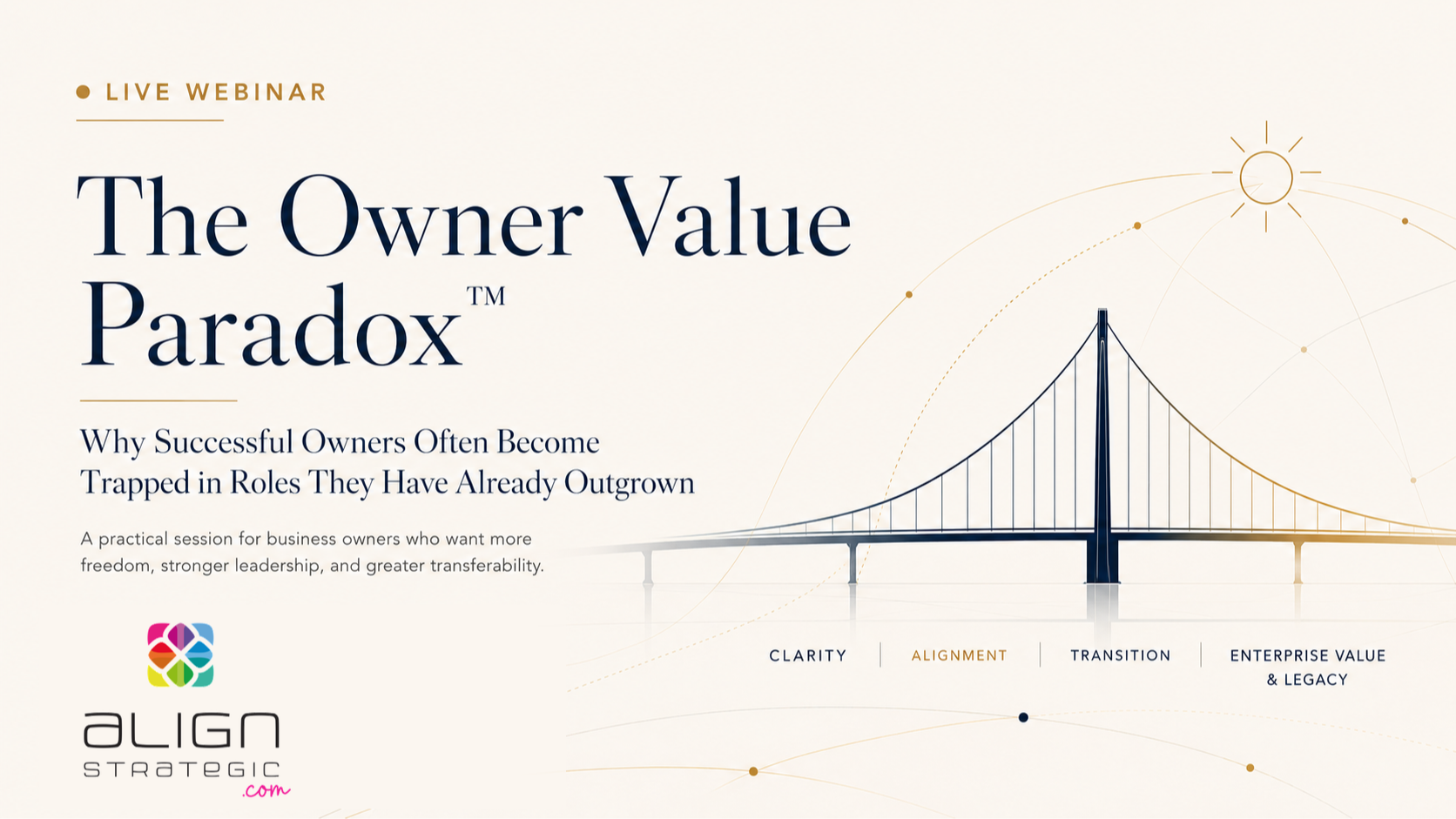
If this article hit a nerve, I’m hosting a free owner workshop called The Owner Value Paradox™: How Much of Your Company’s Value Still Flows Through You?
It is for owners who have built meaningful companies and want more freedom, stronger leadership, greater transferability, and a business that can carry more value without requiring so much of the owner.
What did this bring up for you?
Before you record, listen to the question I ask owners after they read something like this.
Listen to Cheryl’s question first
Then leave me a short voice note about what you are seeing inside your business. Where does the company still depend too much on your judgment, relationships, standards, memory, decision-making, or personal presence?
You do not need to make it polished. Just be specific and share the real issue you are thinking through.
Stay connected with news and updates!
Join our mailing list to receive the latest news and updates from our team.
Don't worry, your information will not be shared.