
Luck Did More of the Work Than You Want to Admit
By Cheryl Powers
Founders who explain success through grit alone usually miss what actually built the business and what may be quietly limiting its value now.
Hard work matters. But timing, structure, readiness, and founder dependence shape business outcomes far more than most owners want to admit, especially when it’s time to scale, transfer, or sell.
A founder sits across from me, proud, tired, and faintly irritated.
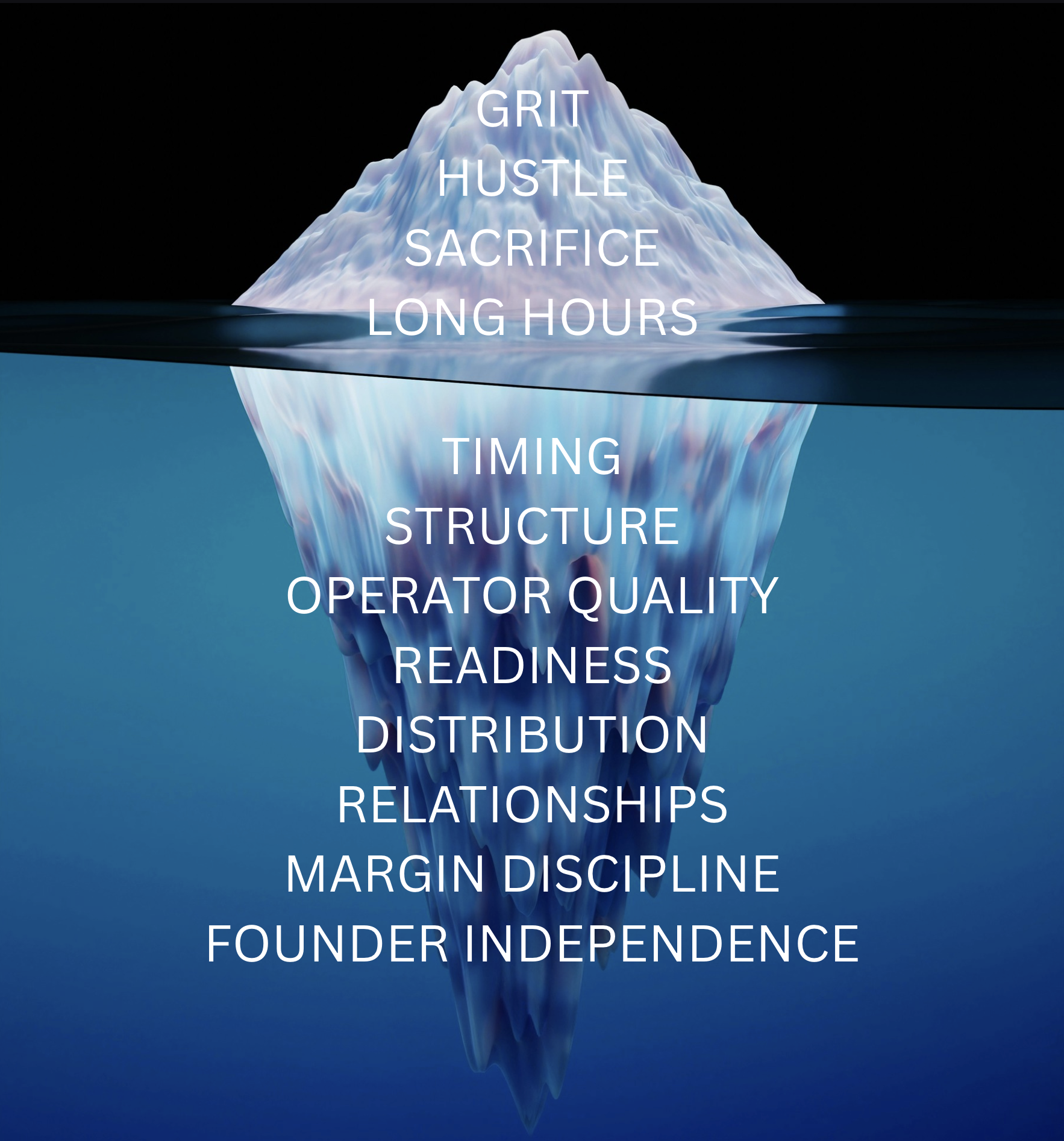
On paper, he’s done everything right. He built the company from almost nothing. He stayed in the game when others quit. He carried payroll through bad quarters. He outworked competitors, protected customers, and absorbed thin margins, painful hires, market shocks, and the private strain that comes with being the one everyone counts on.
He has revenue. He has status. He has a respected company. He has a story.
And the story goes like this: I worked harder than everyone else.
Sometimes that story is true.
It’s almost never the whole truth.
Luck is not a denial of effort. It's the uncomfortable admission that effort was never working alone. That's exactly why the word bothers ambitious founders so much. It sounds like a dismissal of sacrifice, when what it really does is expose how much of the outcome was shaped by timing, conditions, people, and patterns they did not fully create or control.
Stay in the conversation long enough and the hidden layer begins to show. He entered the market at a favorable time. A large customer took a chance on him early. A competitor stumbled. A banker extended grace during a cash squeeze. A key operator arrived when the company needed one most. His childhood taught him vigilance, which helped him in crisis and hurt him in delegation. His intensity created momentum early and bottlenecked growth later. A buyer once showed interest, and he learned that the business was nowhere near as transferable as he imagined.
Now he’s wealthier than he used to be, more accomplished than most people will ever know, and less certain than he wants to admit about what actually explains his success.
Most successful people tell cleaner stories than reality deserves.
The hard work story is emotionally convenient
Founders cling to the mythology of hard work because it does something emotionally useful. It flatters the winner. It preserves dignity. It protects identity. Most of all, it makes the world feel fairer than it is.
If I won because I worked harder, then the outcome says something clean about me. It means I deserve it. It means the chaos wasn’t really chaos. It means the pain meant something. It means I was in control.
That story is satisfying, especially for founders who have genuinely suffered for what they built. It’s also socially useful. It offers a respectable explanation for success without forcing anyone to talk about timing, luck, favorable relationships, or the uncomfortable fact that someone else may have worked just as hard and ended up somewhere entirely different.
But the cleaner the story, the less I trust it.
Because in real companies, outcomes are shaped by far more than effort.
Two founders can work equally hard and still get very different results because one built a credible second layer of management early, while the other kept operating inside noise, turnover, and founder dependency. One built in a geography with better labor access, stronger customer density, and easier distribution. One had an advisor who helped him compress years of mistakes. One was praised early and became more confident taking risk. One was punished early and became more cautious at exactly the wrong moments. One hired a steady operator. The other hired someone he liked.
The work may have been real in both cases.
The outcome still wasn’t explained by work alone.
Most successful people tell cleaner stories than reality deserves.
The two easiest lies about success
When people talk about business success, they usually drift toward one of two lazy explanations.
The first is what I call merit mythology.
Work harder. Stay disciplined. Make better decisions. Stop making excuses. The market rewards value.
There’s enough truth in that story to make it sound wise. Hard work matters. Discipline matters. Standards matter. But as a total explanation, it breaks down quickly. It can’t explain why equally capable people get different outcomes. It can’t explain why one company catches the market at the right time and another misses it by eighteen months. It can’t explain why one founder gets an early champion and another doesn’t. It can’t explain why some companies grow into enterprise value while others grow into expensive dependence.
The second lie is fatalism.
It was all luck. Timing is everything. Success is arbitrary. Nothing can really be controlled.
That story contains truth too. Luck matters. Timing matters. Systems are uneven. Starting points aren’t fair. But as a worldview, fatalism is usually just resignation dressed up in more sophisticated language. It overcorrects. It sees randomness clearly and agency poorly.
Neither story is serious enough. One over-claims control. The other under-claims responsibility. The better answer lives between them.
Luck matters more than most successful people admit. Serious leaders can still get better at working with it.
Luck is rarely a moment. It is usually a pattern.
When people hear the word luck, they often imagine something dramatic: a lucky introduction, a lucky break, a lucky deal, a lucky acquisition offer, a lucky year.
That definition is too small.
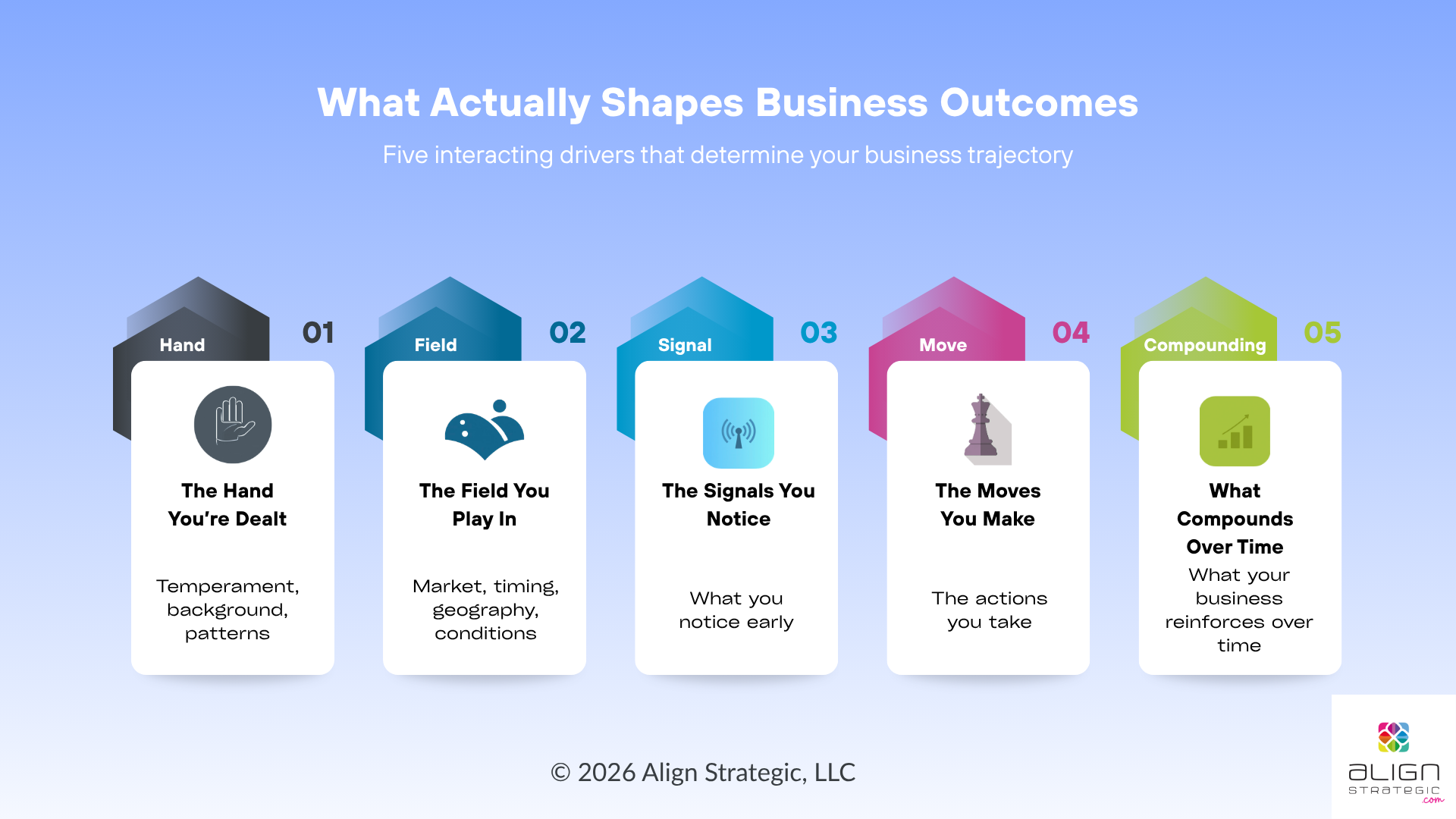
Luck in business is rarely just an event. More often, it’s an interaction. It’s the interplay between the hand you were dealt, the field you operate in, the signals you notice or miss, the moves you make under uncertain conditions, and the way all of that compounds over time.
One founder gets lucky because a customer takes a chance on them early. Another gets unlucky because a key hire leaves at the worst possible moment. But then something deeper happens. The first founder mistakes early tailwinds for personal superiority and keeps the company too owner-centric. The second is forced to build systems earlier than planned and becomes more transferable because of it.
Who was luckier?
That depends on where you stop the story.
This is one of the most useful truths in business, and one of the least respected: most events are misread too early.
A lost customer can expose a dangerous concentration risk. A failed exit can become the first honest audit of owner dependence. A painful executive departure can create the conditions for a stronger leadership structure. A big contract can look like success while quietly increasing fragility. A fast-growth period can hide weak systems, weak margins, and weak transferability.
What looks like luck from the outside is often something far more structural underneath.
Luck can create motion. It can’t create maturity.
What looks like luck is often readiness
Yes, luck matters. Yes, timing matters. Yes, randomness matters.
But what often looks like luck from the outside isn’t blind fortune. It’s readiness meeting uncertainty.
A business gets a shot at a large contract. One company absorbs it, performs, and uses the momentum to improve valuation. Another wins the same kind of opportunity and gets crushed by it because delivery, leadership depth, pricing discipline, and operating rhythm were never strong enough to support the growth.
Same opportunity. Different readiness. Different result.
A founder receives unsolicited acquisition attention. One business commands real interest because authority is distributed, customers aren’t tied too tightly to the owner, and the company can survive the founder’s absence. Another gets the same flattering attention and learns that the business is still too dependent on personal relationships, personal decision-making, and personal rescue to transfer cleanly.
Same luck. Different structure. Different outcome.
Luck can create motion.
It can’t create maturity.
The market does not pay for biography
This is where many founders get hurt. They mistake the pain of building for the value of what was built.
Those aren’t the same thing.
The market doesn't pay a premium because you worked nights. It doesn't pay a premium because you carried stress. It doesn't pay a premium because you sacrificed more than your peers. It doesn't pay a premium because customers love you personally. It doesn’t pay a premium because the company couldn’t have survived without your force of will.
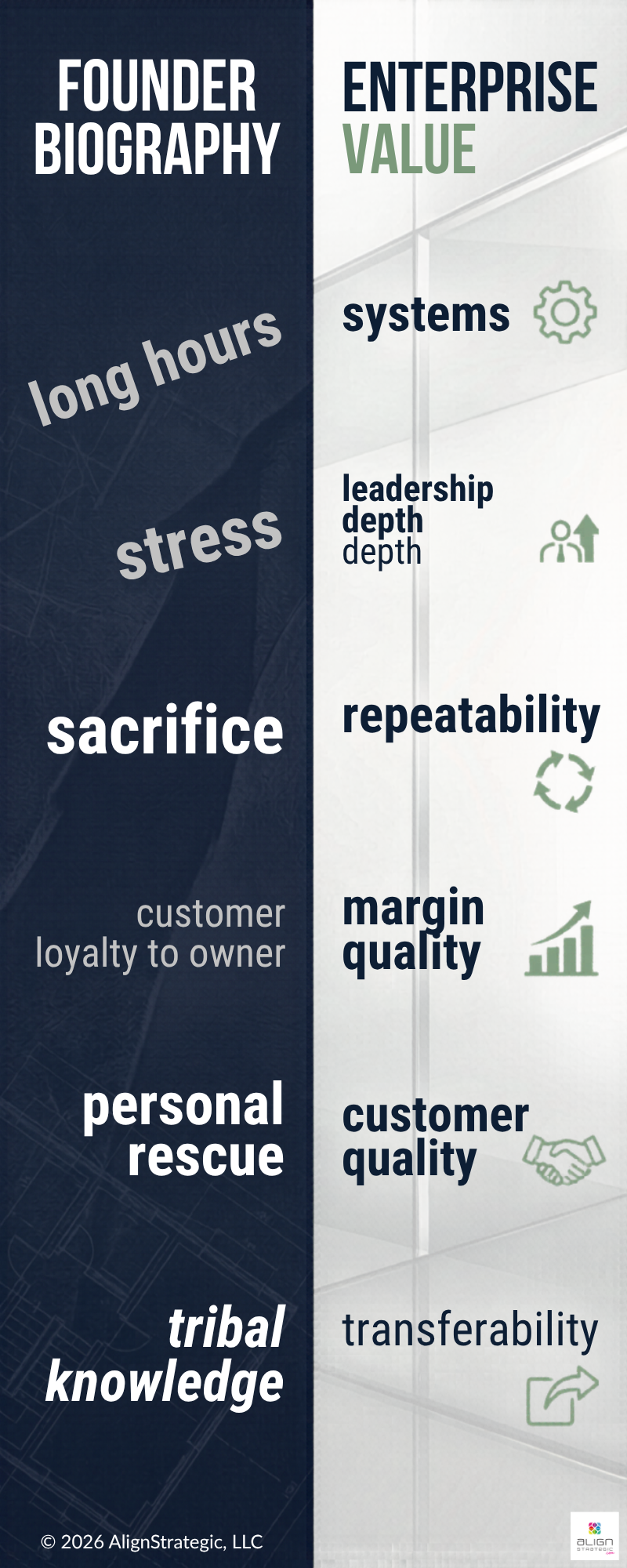
The market pays for what can endure, scale, and transfer.
It pays for systems. Leadership depth. Repeatability. Margin quality. Customer quality. Reduced key-person risk. A business that can function without requiring the founder’s daily intervention to remain coherent.
That’s why so many owners hit a painful stage of maturity. They’ve built something impressive, profitable, and respected, yet not nearly as valuable as they assumed.
They built income and thought they built an asset.
That isn’t bad luck.
That’s delayed truth.
The market does not pay for biography.
A more honest model of success
If hard work isn’t the whole explanation and fatalism isn’t the answer, what is?
A more mature model begins by admitting that outcomes emerge from interaction, not from any single variable.
The hand matters. Your temperament, starting conditions, early exposure, family patterns, confidence, fear, and relationship to control all shape how you build.
The field matters. Industry timing, geography, labor conditions, customer mix, advisors, capital environments, and market shifts either amplify or suppress your strengths.
Signal matters. Some leaders detect early friction, subtle opportunity, and structural weakness faster than others. Others miss what becomes obvious later because identity gets in the way.
The move matters. A leader can know the truth and still delay the act. Companies don’t change because insight appears. They change because a move is made.
Compounding matters. Trust compounds. So does fragility. Leadership depth compounds. So does founder centrality. Transferability compounds. So does dependence.
You don’t get to say, “I earned all of this myself.”
You also don’t get to say, “Nothing can be done.”
You’re living inside forces you didn’t create, forces you can influence, signals you may be ignoring, moves you may be delaying, and patterns you’re compounding whether you intend to or not.
That’s more responsibility, not less.
The useful questions are harder than the motivational ones
This is not an argument against ambition. It’s an argument against simplistic ambition. Simplistic ambition wants a flattering story. Mature ambition wants a useful one.
If you’re building, scaling, or leading a company, the questions that matter are harder than the usual motivational slogans.
What favorable conditions am I taking too much credit for?
What hidden conditions am I failing to respect?
Where has luck helped me and made me overconfident?
Where has pain helped me and made me wiser?
What in this business still depends too much on my memory, my relationships, my intervention, or my identity?
What would a serious buyer, successor, or operator see that I’m still defending?
What opportunities could this company use well?
Which ones would expose it?
What am I compounding right now, even if I don’t like the answer?
These aren’t just philosophical questions. They're valuation questions. Leadership questions. Freedom questions.
The strongest founders are not embarrassed by luck
The strongest founders aren't the ones who deny luck. They’re the ones who stop being embarrassed by it. They can admit that timing helped. They can admit that people opened doors. They can admit that they inherited some strengths and some distortions. They can admit that luck gave and luck took. They can admit that some of their best outcomes were shaped by conditions they didn’t create.
And because they can admit that, they become more serious about the part they can influence.
They build companies that are less dependent, more durable, and more real. They take signal more seriously. They act before certainty arrives. They stop confusing founder importance with enterprise value. They invest in leadership depth, not just output. They become less theatrical and more structurally honest.
That’s what mature agency looks like.
Not control. Not passivity. Not self-congratulation. Not resignation.
A better relationship with reality.
And in business, that may be one of the few advantages that actually compounds.
That’s why the story matters. If you misunderstand what created your success, you’ll almost certainly misunderstand what sustains value, what transfers cleanly, and what a buyer, successor, or leadership team will trust. Founders don’t lose optionality because they worked too little. They lose it because they built a company around a story that was never structurally true.
Founders often explain success with effort because effort flatters identity. But effort is only one thread in a much larger fabric. The real story is the interaction between hand, field, signal, move, and compounding. That is what determines whether a company becomes merely impressive or genuinely valuable.
That is a framework you can build around.
If this article hit a nerve, it should. Most owners are working hard to grow a company they haven’t yet made transferable. Subscribe for weekly insights on value growth, leadership depth, succession planning, and building a business that can thrive without you. Get your enterprise value scorecard here.
Free Owner Workshop
If this article hit a nerve, I’m hosting a free owner workshop called The Owner Value Paradox™: How Much of Your Company’s Value Still Flows Through You?
It is for owners who have built meaningful companies and want more freedom, stronger leadership, greater transferability, and a business that can carry more value without requiring so much of the owner.
What did this bring up for you?
Before you record, listen to the question I ask owners after they read something like this.
Listen to Cheryl’s question first
Then leave me a short voice note about what you are seeing inside your business. Where does the company still depend too much on your judgment, relationships, standards, memory, decision-making, or personal presence?
You do not need to make it polished. Just be specific and share the real issue you are thinking through.
Stay connected with news and updates!
Join our mailing list to receive the latest news and updates from our team.
Don't worry, your information will not be shared.