Luck Gets Better When the Business Stops Needing You So Much
By Cheryl Powers
Most founders say they want to get lucky.
They want the right buyer to appear, the right leader to join, the right customer to expand, the right market window to open, the right offer to arrive before energy, timing, or health changes the options available to them.
That kind of luck does exist. But it is not the kind most owners should be waiting for.
The more useful kind of luck is built before the opportunity arrives. It's built in the years when no one is watching, when the owner is still making daily decisions, still protecting customer relationships, still fixing problems before they spread, and still telling themselves the company works because they are willing to do what others will not.
That story contains both truth and risk.
Because a business can be profitable, respected, and growing while still carrying too much of its value through the owner. The customer trust flows through the owner. The standards flow through the owner. The judgment flows through the owner. The difficult decisions flow through the owner. The emotional steadiness of the company flows through the owner.
From the inside, this can feel like leadership.
From the outside, and eventually in a transition, it can look like concentration risk.
And that's where luck starts to change.
A business gets luckier when customer confidence is no longer so personal. It gets luckier when leaders can make mature decisions without waiting for the owner’s interpretation. It gets luckier when the company has enough structure to hold standards without relying on the founder’s nervous system. It gets luckier when buyers, successors, employees, and capital providers can believe the business will keep working after the owner steps back.
That kind of luck is not mystical. That's the art and science of transferability.
Owners often overestimate the role of timing and underestimate the role of readiness. They imagine the right buyer as a lucky event, when in reality the right buyer often reveals whether the business had already become transferable or not. They imagine a strong offer as market validation, when it may simply expose how much the company still depends on the person who built it because the details include a steep earnout or gets retraded late in the deal process.

This is why some owners feel blindsided during succession or sale conversations.
The company may be successful. The owner may be admired. Revenue may be strong. The brand may be respected.
And still, the value may not be carrying cleanly.
The market doesn't simply ask, “Was this hard to build?”
It asks, “Can this value continue without the founder carrying so much of it personally?”
That question can feel unfair to owners because the business often did need them. In the early years, their intervention protected quality. Their relationships created trust. Their speed created momentum. Their judgment prevented expensive mistakes. Their intensity held the company together.
Those traits may have been essential. But what was essential in one stage can become expensive in another.
At some point, the work of ownership changes. The job is no longer to prove that the company still needs you. The job is to build a company that can carry more value without requiring so much of you.
That's not withdrawal. That is value creation.
A founder who stays personally central to every meaningful relationship may feel close to the customer. But a buyer sees fragility. A founder who remains the final interpreter of quality may feel committed to standards. But a leadership team learns to borrow judgment instead of developing it. A founder who steps into every difficult conversation may feel responsible. But the company never builds the muscle to resolve complexity without rescue.
These patterns are easy to defend because they often began as strengths.
The owner didn't create dependence by being careless. Usually, the opposite is true. The owner cared deeply. The owner was the one who saw what others missed. The owner intervened because failure had real consequences. The owner became central because centrality worked.
Until it didn't.
The hard part is recognizing that the same pattern that once created value may now be preventing value from transferring.
This is where the conversation about luck becomes more useful.
You get luckier when the business becomes easier to trust.
You get luckier when the next layer of leadership owns outcomes, not just tasks.

You get luckier when customer confidence belongs to the company, not only to the founder.
You get luckier when the operating rhythm is clear enough that people know how to make decisions without constant upward escalation.
You get luckier when the company’s value lives in systems, people, process, culture, customer quality, and repeatability and not mostly in the owner’s presence.
These things matter long before a sale.
They matter if you want more freedom.
They matter if you want to scale.
They matter if you want to develop a leadership team.
They matter if you want the business to become less exhausting.
They matter if you want optionality.
And all of this matters deeply if you ever want to step forward into a new role, step up into a more strategic seat, step back from daily operations, or eventually sell without the regret 75% of business owners feel a year after they've sold their company.
Many owners assume regret happens after the sale because the deal was wrong, the buyer was wrong, or the next chapter was unclear. Sometimes that is true. But often, regret begins much earlier. It begins when the owner never fully separated personal significance from enterprise value.
The business meant something. Of course it did.
It created identity. Contribution. Impact. Legacy. Purpose. Status. Belonging. Proof.
That meaning is real and it shouldn't be dismissed. In fact, it should be taken more seriously than most advisors take it.
Because if ownership has been one of the primary places where you as an owner experiences significance, then “letting go” is not a mechanical event. It is not solved by a checklist. It is not solved by telling the owner to delegate more, care less, play golf, or find a hobby.
That advice often misses the point entirely. As the owner, you're not merely attached to tasks. You're attached to what the business has meant. And that's why the next stage has to be designed differently.
The business has to learn how to carry more value. And you have to understand what value you're ready to carry forward with you. That's the real work. It's strategic. It's operational. It's emotional. It's financial. And it's deeply practical.
And it changes the odds.

If you want to get luckier as an owner, don't simply wait for the right buyer, the right leader, or the right moment. The right moment is now.
Ask where the business still needs too much of you.
Ask where value still flows through your relationships, your standards, your memory, your judgment, your intervention, or your identity.
Ask whether the company is becoming more transferable as it grows, or simply more impressive while remaining too owner-held underneath.
That's where better luck begins. Not in waiting for the future to arrive, but in building a company that's ready when it does.
Business Owner Workshop
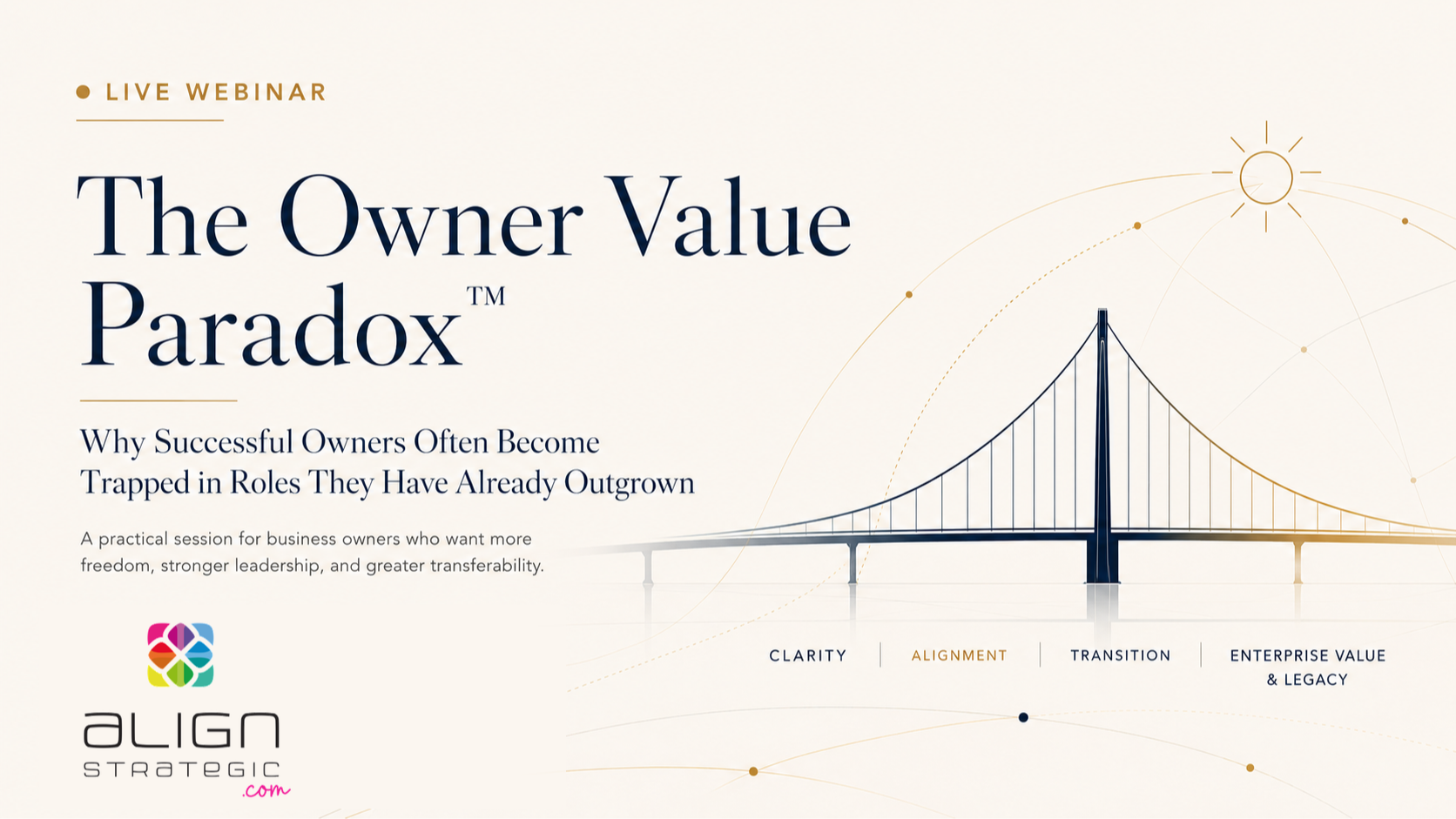
If this hit a nerve, I’m hosting a free owner workshop called The Owner Value Paradox™: How Much of Your Company’s Value Still Flows Through You?
It is for owners who have built meaningful companies and want more freedom, stronger leadership, greater transferability, and a business that can carry more value without requiring so much of the owner.
What did this bring up for you?
Before you record, listen to the question I ask owners after they read something like this.
Listen to Cheryl’s question first
Then leave me a short voice note about what you are seeing inside your business. Where does the company still depend too much on your judgment, relationships, standards, memory, decision-making, or personal presence?
You do not need to make it polished. Just be specific and share the real issue you are thinking through.
Stay connected with news and updates!
Join our mailing list to receive the latest news and updates from our team.
Don't worry, your information will not be shared.