Hard Work Becomes Dangerous When It Turns Into the Only Explanation

By Cheryl Powers
Hard work is one of the easiest things for founders to overcredit because it's one of the few things they know with certainty was real.
They remember the long hours they spent building the business. The payroll stress. The customer problems they absorbed before anyone else saw them. The quarters they held together through force of will. The years they carried too much because no one else was ready to.
That part is real. Which is exactly why it becomes dangerous.
The problem with hard work is not that it is false. The problem is that it is true enough to become a complete explanation. And once that happens, founders start putting effort into explaining outcomes that were actually formed by timing, people, structure, conditions, and luck.
Then they start building the next stage of the company around the wrong lesson.
That gets expensive.
Why Hard Work Is Such a Seductive Story
Hard work is not simply an operational reality. It’s also emotionally useful.
It preserves dignity. It gives suffering meaning. It makes the outcome feel earned in a clean and morally satisfying way. It turns difficulties into proof of character. It lets founders believe the result came from discipline rather than from a messier mix of timing, help, market conditions, and uneven advantage.
If I won because I worked harder, then the story says something pure about me. It means I deserved it. It means the pain counted. It means I wasn't merely fortunate. It means I was in control.
That’s an intoxicating explanation, especially for founders who genuinely suffered for what they built.
It’s also one of the easiest explanations to become trapped inside. Because once hard work becomes the founder’s master explanation, it starts determining how they respond to every new stage of the business.
The next problem gets solved with more effort. The next gap gets solved with more founder involvement. The next period of friction gets solved with more oversight, more control, more rescue, and more personal sacrifice. The founder starts using the same tool for every kind of problem because that tool worked before.
That’s where the trouble begins.
What Saved the Business Early Can Quietly Cap It Later
There's a pattern that often shows up in founder-led companies with revenue between 10 and 35 million. The founder is usually not lazy, entitled, or detached. Usually, the opposite is true.
They're respected because they carried the company through years that would have broken weaker people. They know the customers. They know the numbers. They know where mistakes happen. They can smell trouble early. They earned trust the hard way.
But because they earned that trust through effort and vigilance, they keep treating effort and vigilance as the answer to problems that are no longer personal.
That is the trap.
A founder who built through sacrifice starts romanticizing sacrifice. A founder who built through speed starts distrusting process. A founder who built through personal rescue starts underinvesting in institutional strength.
And because the company may still be growing, the pattern can stay hidden in plain sight for years.
Revenue increases. Complexity rises. Dependence increases faster.
The founder mistakenly conflated continued involvement with continued value creation.
But those are not always the same thing.
The Industrial Services Owner Who Couldn’t Stop Being the Closer
We worked with a 22-million-dollar industrial services company whose founder was understandably proud of how he had built the business.
He came through an ugly early period with a record of reliability. He would stay later than anyone, personally handle customer problems quickly, rework pricing when a job started drifting, and personally save relationships when execution got messy. Customers trusted him because he had earned that trust over time and under pressure.
That history became his management model.
Even as the company grew, he remained the final voice on major proposals, difficult customer conversations, and anything that appeared commercially risky. He called it discipline. He called it protecting quality. He called it staying close to the customer.
All of that sounded responsible. It was also keeping the business from maturing.
His sales leaders stopped developing commercial judgment because the founder kept acting as the real closer. Account managers escalated too quickly because they knew he would step in. Operators learned that rescue mattered more than prevention. From the outside, the company looked deeply customer-centric. From the inside, it was still wired around founder intervention.
He didn’t have a hard work problem. He had an explanation problem. He told me the company won because he stayed closer than everyone else.
He was slow to see that this was no longer the source of strength. It had become the reason customer confidence was still too personal, commercial authority was still too centralized, and leadership depth was still too thin.
Hard work had become a beautiful explanation for an expensive pattern.
The Distributor Who Confused Endurance With Design
A 14-million-dollar specialty distribution company had a founder who was known internally for outlasting chaos.
He had survived supply shocks, ugly customer behavior, margin pressure, and years of operational noise. When we met, he was proud, with good reason, to be the person who never let the company down.
But because he had lived through so much instability, he developed a quiet belief that the business worked mainly because he could absorb more than other people could.
So, every time business complexity increased, he inserted himself more deeply.
He reviewed exceptions. Reworked purchasing calls. Rechecked hiring decisions. Stayed too close to customer issues. Kept key vendor relationships tightly personal. He told himself the business needed toughness at the center.
What it actually needed was a stronger operating design.
His version of leadership had become highly effortful and increasingly non-transferable. The company didn’t lack heart. It lacked the distributed authority and strong operational clarity to function without his nervous system at its center.
Again, the issue wasn’t that the hard work was fake.
The issue was that hard work had become the founder’s preferred explanation for the company's survival, so he kept relying on effort where operational design was required.
The Manufacturer That Mistook Intensity for the Growth Engine
Another client, a 31-million-dollar manufacturer, grew quickly after landing a major account.
The founder was sharp, commercially aggressive, and fully capable of outworking slower competitors. He told me how he had built the company through real uncertainty, and it was clear he deserved real credit for surviving long enough to catch the opportunity.
But he told himself a story about the growth that was too flattering and too narrow.
He believed the company scaled because he wanted it more, acted quicker, and stayed tighter with the customer than anyone else in the field.
There was truth in that. And there was also a larger reality.
The customer needed a new supplier fast. A competitor had messed up. Capacity happened to be available. A key operations leader had joined six months earlier and quietly stabilized execution. The market gave the founder a window he did not fully create.
But because he explained the growth mainly through personal intensity, he built the next chapter around more of the same. More approvals through him. More customer dependence on him. More escalation to him. More strategic decisions relying on him. More confidence that his continued closeness was the asset.
Revenue grew. And so did fragility.
When buyer interest began, he was shocked by what was discounted. Customer concentration. Thin leadership depth. Too much operating confidence tied to one person. Too little evidence that the company could absorb scale or transition cleanly.
He thought the company had become more valuable because it had become bigger. What had actually happened was more subtle.
The company had grown while staying too loyal to the founder’s preferred explanation of why it worked.
That’s a different kind of risk, and buyers know how to hear it.
Why Founders Keep Reaching for Effort Even When Effort Is No Longer the Answer
Founders reach for hard work because hard work feels controllable.
Structure takes longer. Leadership development is slower. Decision rights are messier. System-building is less emotionally rewarding. Letting other people own outcomes creates visible imperfection.
Working harder feels cleaner.
It lets the founder stay in motion. It keeps identity intact. It avoids the more threatening possibility that the next stage of value creation may require a different role, not just more sacrifice.
That’s why some very successful founders stay trapped in an early-stage leadership pattern long after the company has outgrown them.
These founders aren’t weak. They’re overloyal to the trait that made them admirable.
That distinction matters.
The founder isn’t usually making a lazy mistake. They’re making a loyal mistake. They’re staying faithful to the very behavior that once protected the company.
But a behavior can be honorable and still be outdated.
What Hard Work Can and Can’t Do
Hard work can keep a company alive. It can restore a customer. It can carry a painful quarter. It can force motion when the team is too thin and the field is unforgiving.
What it can’t do forever is substitute for structure.
It can’t create leadership depth on its own. It can’t reduce key-person risk on its own. It can’t make customer confidence transferable on its own. It can’t turn personal heroics into institutional value.
At some point, more effort stops being a growth strategy and starts becoming a way to conceal what the company hasn’t built yet. That’s a painful shift for founders because it feels as if the old virtues are being demoted.
They’re not being demoted. They’re being repositioned.
The next stage doesn’t require less character. It requires that character be expressed differently.
Less rescue. More design.
Less personal control. More distributed capability.
Less admiration for endurance. More respect for repeatability.
That’s a different form of leadership, and not every founder makes the turn without help.
The Better Question for a Serious Founder
The question isn’t whether you worked hard. You probably did.
The better question is whether hard work has become too important in the way you explain your company’s success.
Because if effort is still your main explanation, there’s a good chance effort is still your main instrument. And if effort is still your main instrument, there’s a good chance the business is more dependent on you than your numbers suggest.
That’s where mature founders become far more useful to their companies.
They stop worshipping effort as the universal answer. They stop treating sacrifice as proof of structural strength. They stop confusing their importance with enterprise value.
And they start asking better questions.
Where am I still using effort to compensate for weak design?
What does this business still demand from me that it should have learned to do without me?
Which parts of our performance come from institutional strength, and which parts still come from my personal force?
What am I calling 'standards' that may actually be 'control'?
What am I calling commitment that may actually be dependence?
Those are harder questions than the usual slogans.
They’re also far more valuable. Because hard work is real. That’s what makes it dangerous when founders turn something real into something complete.
A founder who explains too much through effort usually ends up solving too much through effort, too. That’s when a genuine strength begins to distort strategy, limit leadership depth, and quietly cap enterprise value.
The issue isn’t effort. It’s your explanation.
If this article hit a nerve, it may be because the business is still relying on more of you than the numbers reveal. That is not unusual. But it is costly. Start by assessing how transferable your company really is and where founder dependence is quietly limiting value.
Free Owner Workshop
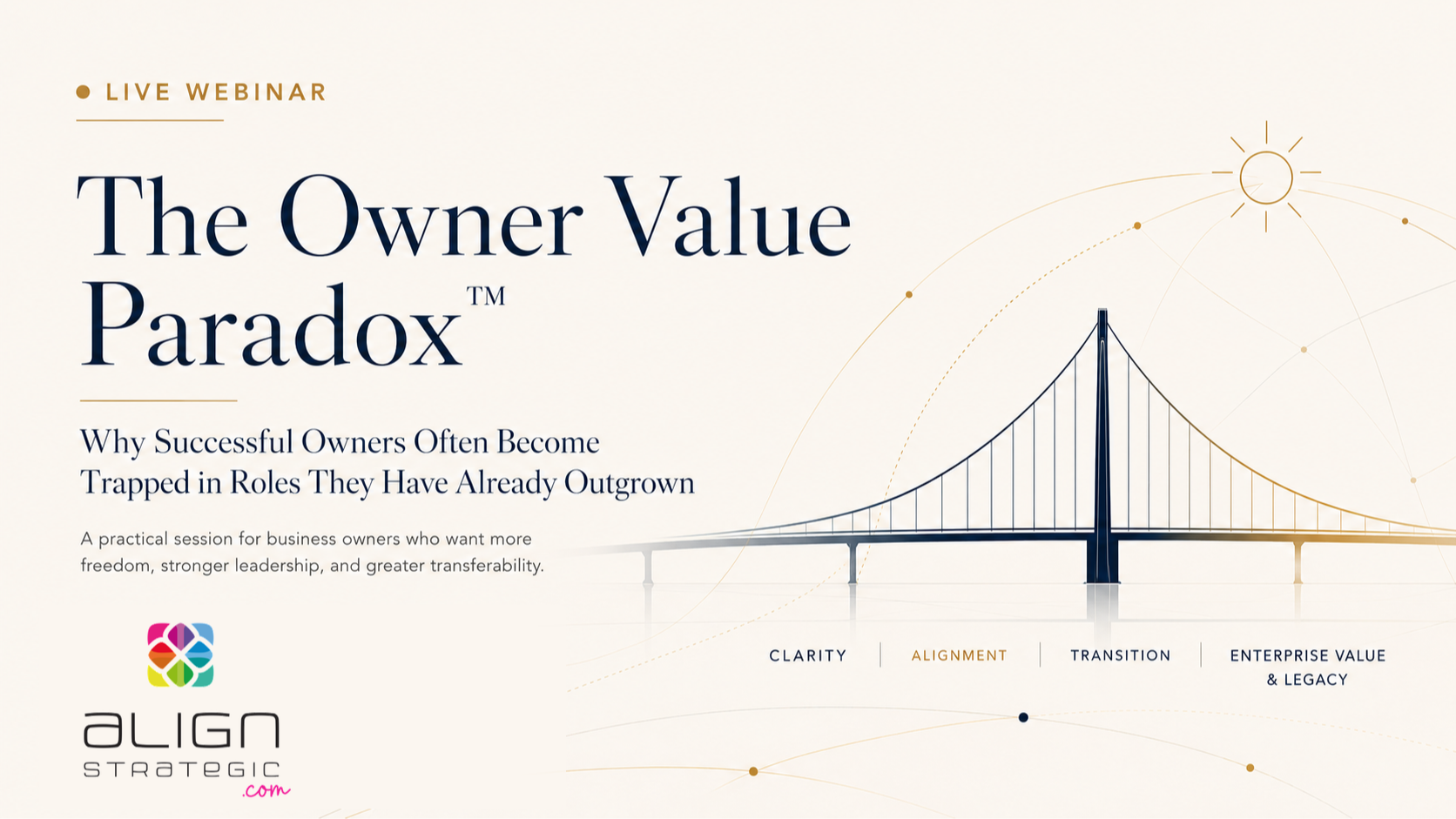
If this article hit a nerve, I’m hosting a free owner workshop called The Owner Value Paradox™: How Much of Your Company’s Value Still Flows Through You?
It is for owners who have built meaningful companies and want more freedom, stronger leadership, greater transferability, and a business that can carry more value without requiring so much of the owner.
What did this bring up for you?
Before you record, listen to the question I ask owners after they read something like this.
Listen to Cheryl’s question first
Then leave me a short voice note about what you are seeing inside your business. Where does the company still depend too much on your judgment, relationships, standards, memory, decision-making, or personal presence?
You do not need to make it polished. Just be specific and share the real issue you are thinking through.
Stay connected with news and updates!
Join our mailing list to receive the latest news and updates from our team.
Don't worry, your information will not be shared.