You Get Luckier When the Business Stops Bleeding in Places You Don’t See

By Cheryl Powers
Founders talk about luck as if it comes from outside the business. In reality, a surprising amount of luck is built from the inside through cleaner systems, better people, tighter priorities, stronger margins, and fewer invisible leaks in cash flow, compliance, and execution.
Luck Doesn't Just Arrive as Opportunity
A lot of owners say they want to get lucky.
What they usually mean is that they want the right customer, the right hire, the right buyer, the right market window, the right break.
What they miss is that a meaningful amount of business luck is not random in the way they think. Much of it is operational.
You get luckier when the company stops making avoidable mistakes. You get luckier when information moves clearly. You get luckier when margin is no longer leaking through weak processes, bloated payroll assumptions, bad handoffs, sloppy billing, poor collections, or founders staying too close to work that should have been redesigned long ago. You get luckier when the business becomes easier to trust.
That’s the part many owners don’t want to hear, because it is less flattering than the usual mythology of entrepreneurial success. It is more fun to tell a story about vision, grit, speed, and persistence than to admit that many outcomes are shaped by whether the company is clean or messy underneath.
But that’s how real businesses work. Luck doesn’t just show up as opportunity. It also shows up as avoided damage.
And some of the most expensive bad luck in business is not bad luck at all. It is unmanaged drag that sat inconspicuously inside the company until the day it finally became visible.
Founder-led companies create operational drag all the time without meaning to. The owner is not being careless. Usually, the opposite is true. They’re committed, overextended, and trying to grow. But they are too close to certain costs, too used to certain workarounds, or too conditioned to assume that because something is getting done, it is getting done well.
That is how hidden inefficiency survives.
A founder sees payroll going out every two weeks and assumes the function is handled because people are getting paid. A founder sees invoices being sent and assumes the revenue process is fine because billing exists. A founder sees a long-tenured employee covering five different responsibilities and assumes that keeping the work in-house must be the most efficient answer. A founder sees effort and mistakes it for strength.
Sometimes, what the owners are really looking at is expensive loyalty to a weak design.
The Hidden Cost of Expensive Loyalty to Weak Design

This happens all the time in good, respectable companies. The revenue is real. The customers are real. The team is working hard. But the internal architecture is looser than it should be, and the owner hasn’t stepped back long enough to ask the harder question:
Where are we carrying cost, risk, or friction simply because no one has rebuilt the way this actually works?
That’s not an innocuous question. That question shapes margins. It shapes cash flow, compliance, and management burden. It also shapes whether the owner keeps getting pulled into issues that should never have remained so complicated.
And it also shapes luck.
The Payroll Problem That Could Have Turned Costly Fast

We worked with a client whose payroll function had become far more complex than the owner appreciated. This was not a business running a simple salary cycle. There were hourly employees, salaried employees, commissions, bonuses, overtime, PTO, deductions, and enough moving parts that payroll had become a risk point rather than a routine function.
Nothing looked obviously broken at first. People were being paid. The business was moving. Payroll was simply one more thing getting done.
Until it wasn’t.
A payroll tax filing issue surfaced, and the company had inadvertently made a mistake that could have become expensive very quickly. If that issue had continued unresolved, the owner could have faced penalties, administrative disruption, wasted leadership time, and an entirely unnecessary compliance problem.
That’s the kind of thing owners often experience as bad luck. Most of the time, it is not. Most of the time, it’s the cost of a function becoming more complex than the system supporting it.
We suggested the client begin working with one of our partners. The partner reconciled the issue, corrected the filing problem, and got it resolved with no penalty to the client. That was a meaningful savings on its own. But the larger value was much bigger than the avoided expense.
- The owner stayed compliant.
- The issue was contained early.
- The company avoided the kind of mess that absorbs attention and creates stress far out of proportion to the original mistake.
- A point of hidden operational drag became visible and fixable.
If that had gone another way, the owner would have said they got unlucky. The truth is, they got lucky because the issue was surfaced and corrected before the cost multiplied.
That's a different kind of luck.
And serious owners need a more mature relationship with that idea.
Most people still think luck in business is mainly about upside. The right introduction. The right account. The right acquisition interest. The right market timing. The right growth window.
But another kind of luck matters just as much.
The luck of not being penalized because you found the issue in time.
The luck of not losing a customer because someone cleaned up the billing process before trust eroded.
The luck of not missing payroll because cash forecasting got tighter before the squeeze hit.
The luck of not carrying bloated overhead for three extra years because someone finally admitted the org chart was built around habit, not design.
The luck of not being discounted in diligence because weak process, concentration, and dependence were reduced before the market saw them.
That kind of luck is not mystical. It’s engineered and built.
The Companies That Get Luckier Over Time Usually Run Cleaner

This is one reason owners who become more operationally serious often look luckier over time. They’re not necessarily more charismatic. They’re not always more visionary. They’re not even always more aggressive.
They simply allow fewer invisible leaks to stay invisible.
They redesign sooner.
They ask better questions sooner.
They stop assuming that because something is being handled, it is being handled well.
They stop confusing continuity with quality.
That is where margin improves in ways many founders do not expect.
And it doesn’t always happen through dramatic revenue growth. Sometimes it happens through cleaner role design, better vendor choices, and tighter payroll and billing processes. Sometimes it’s stronger collections, better compensation architecture, better use of outsourced expertise, better systems around recurring administrative complexity, better judgment about what should be automated, what should be delegated, and what should never have remained on the owner’s plate in the first place.
Founders often underestimate the cost of operational clutter because clutter accumulates gradually.
It starts with one person doing too much and another person doing the wrong level of work for their cost.
Or a manual process survives because no one ever stopped to redesign it.
Or a compliance function stays internal even though nobody inside the company is really equipped to run it cleanly.
Or a billing process keeps creating lag because the handoffs were never fully mapped.
Or payroll gets more complex as the company grows, but the process supporting it stays amateur relative to the stakes.
None of that feels dramatic in the day-to-day. But taken together, it creates significant drag.
And drag is one of the least respected destroyers of luck in a growing company.
Because drag doesn’t just reduce efficiency. It lowers the quality and the value of the whole business.
It pulls energy away from real leadership.
It burns management time on avoidable noise.
It hides margin.
It increases risk.
It delays decisions.
It makes the company feel heavier than it should.
And most of all, it keeps the owner involved in places where the business should already be cleaner, more visible, and better supported.
This is why serious value growth is never just about growth. It’s also about reduction.
Reducing friction. Reducing blind spots. Reducing preventable errors. Reducing unnecessary payroll burden. Reducing compliance exposure. Reducing the number of places where complexity is allowed to live without enough structure around it.
In other words, serious value growth is partly the discipline of becoming less easily damaged.
That’s one of the most underrated ways owners get luckier. They build companies that are less vulnerable to the ordinary stupidity of weak design. And the market rewards that, even if owners don’t always name it clearly enough.
A company with tighter systems, cleaner execution, better visibility, stronger people, fewer hidden leaks, and less dependence on founder intervention is not just easier to run. It is also more resilient, more profitable, more sellable, and more valuable.
It has significantly better odds.
And that’s what many founders really mean when they say they want to get lucky. They want better odds. They want fewer expensive surprises. They want more margin for error. They want more freedom. They want a company that doesn’t punish them every time complexity increases.
Those things aren’t stumbled across. They’re built into the operating system.
The Better Question for a Serious Owner
So instead of asking, “How do I get lucky?”
Ask:
Where is this business still making itself easier to hurt than it should be?
Where are we tolerating complexity without enough structure?
Where are we paying for noise, rework, poor role design, weak systems, or preventable risk simply because no one has stepped back and rebuilt the way the work actually happens?
Where is the hidden drag suppressing margin, cash flow, compliance, leadership capacity, and enterprise value?
Those are better questions because they lead to real advantage.
Luck matters. Of course it does.
But founders who optimize the right things, systematize the right things, strengthen the right people, clean up the right processes, and reduce the right forms of drag don’t eliminate uncertainty. But what they do is stop donating so much of their future to preventable mistakes.
And that is one of the most practical ways a company gets lucky on purpose.
If this hit a nerve, the next question is not whether your company is growing. It's whether it is getting cleaner, less dependent, and less easy to damage as it grows. That's the work that improves freedom now and value later.
Free Owner Workshop
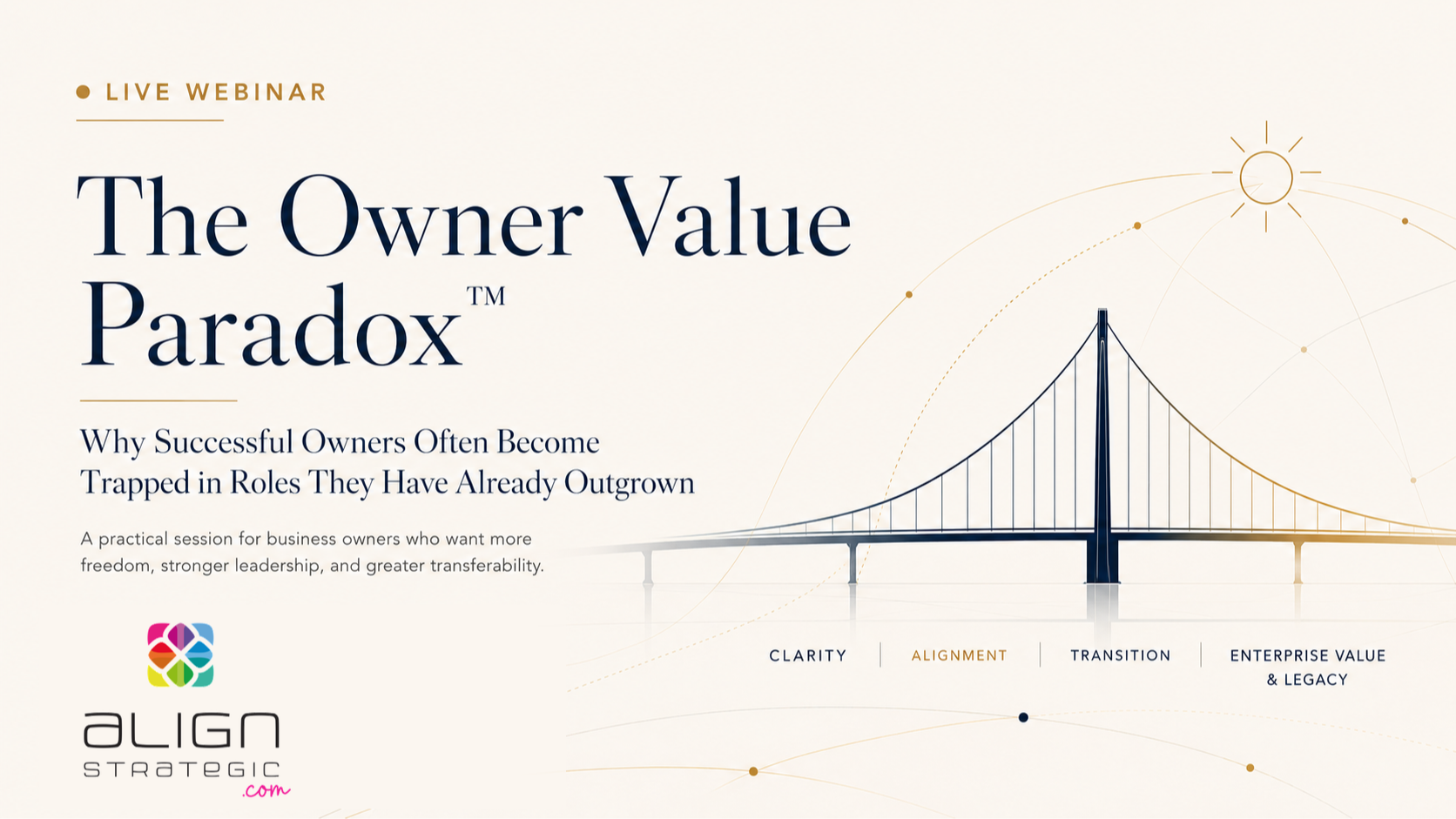
If this article hit a nerve, I’m hosting a free owner workshop called The Owner Value Paradox™: How Much of Your Company’s Value Still Flows Through You?
It is for owners who have built meaningful companies and want more freedom, stronger leadership, greater transferability, and a business that can carry more value without requiring so much of the owner.
What did this bring up for you?
Before you record, listen to the question I ask owners after they read something like this.
Listen to Cheryl’s question first
Then leave me a short voice note about what you are seeing inside your business. Where does the company still depend too much on your judgment, relationships, standards, memory, decision-making, or personal presence?
You do not need to make it polished. Just be specific and share the real issue you are thinking through.
Stay connected with news and updates!
Join our mailing list to receive the latest news and updates from our team.
Don't worry, your information will not be shared.