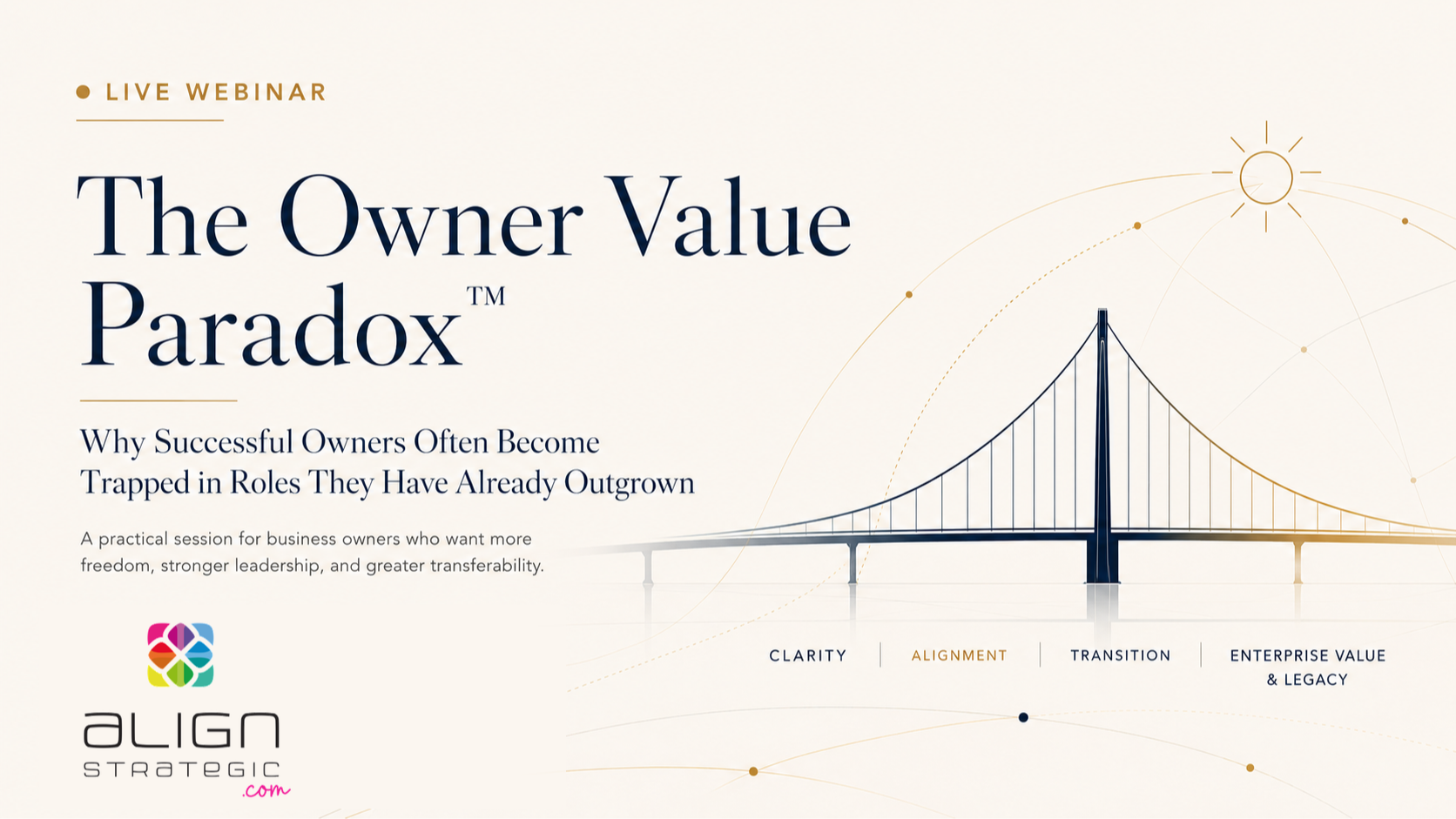
You’re Leaving Money on the Table: The Hidden Growth Strategy Your Business Needs

By Cheryl Powers
At your size, growth rarely stalls because of market demand or team talent. The real reason your business isn’t growing faster is because you, the owner, have quietly become the bottleneck.
When every major decision, client escalation, and strategic trade-off routes back to you, the business develops a single point of failure. This dependency creates a throughput ceiling where revenue can’t grow faster than your time, attention, and tolerance for chaos. The result? Slower growth, unnecessary stress, and zero freedom. And if left unresolved, this founder dependency becomes an enterprise value killer, because no serious buyer or investor will pay a premium for a business that only works when you’re in the room.
It’s Not the Economy, Your Competition, or Your Team. The Bottleneck IsYou
Most business owners don’t realize it, but their biggest growth problem isn’t external—it’s internal.
If the decisions, the client issues, the operational fires, and the strategic initiatives all flow through you, the owner, you don’t have a company. You have a job masquerading as a company. And no matter how hard you work, how many people you hire, or how many hours you add to your week, your business will never outgrow your personal capacity.
This uncomfortable truth is the dividing line between businesses that plateau at $5–$15 million and those that scale to $30–$50 million plus, turning into tangible wealth-building assets for their owners.
When the business depends on the owner, it becomes fragile, slow, and limited. But when the company runs on systems and leadership, instead of the founder, it becomes scalable, sellable, and profitable. It becomes a cash machine that enhances your freedom while you own it.
The Hard Truth: Control Feels Safe, But It’s Killing Your Growth

Most entrepreneurs start as the engine of their business. In the early years, it’s your drive, vision, and grit that get things off the ground. You should be in everything at the beginning. But what got you here will not get you there.
As your company hits that $10M–$50M revenue range, growth is no longer limited by hustle. It’s limited by structure or, more accurately, the lack of it.
Here’s how founder bottlenecks silently strangle growth:
- Every major decision waits on you. This means nothing moves faster than your inbox.
- You solve all the “important” problems. This means your team doesn’t grow, but your stress does.
- Your company has no real operating system. This means scaling just creates more chaos, not more profit.
- You’re working harder than ever but earning less, with less freedom.
This creates a business that looks successful on the outside but feels like a prison on the inside.
Why Hiring More People Won’t Fix Scaling Beyond You
This is the first trap owners fall into: the assumption that the solution to overwhelm is more bodies.
- I just need a COO.
- I just need better managers.
- I just need more people to take things off my plate.
But here’s the problem: if your systems are broken, adding more people only makes the problem worse. Hiring people into a broken system creates confusion, dependency, and frustration. Instead of freeing you, it pulls you deeper into the weeds because now you’re managing more moving parts without a real structure.
People don’t solve process problems. Process solves people problems.
The Real Cost of Being the Bottleneck
The bottleneck isn’t just an operational inconvenience—it’s a direct hit to your valuation, profitability, and freedom. Here’s what it’s costing you right now (whether you can see it or not):
Lost Speed = Lost Opportunities
When your team waits for your green light, even on a handful of things each week, opportunities die in limbo. Competitors move faster, projects stall, and innovation gets strangled by approval chains that lead only to you.
Burnout and Decision Fatigue
You’re making dozens of decisions a day that shouldn’t even be on your plate. That’s not leadership; that’s operational quicksand.
Stunted Team Growth
Your best people will leave if they’re never empowered to lead. A-players want autonomy, not permission slips.
Reduced Enterprise Value
Buyers don’t buy you. They buy transferable systems. The more your company depends on you, the lower your multiple and the harder it is to sell.
Financial Drag
Bottlenecks create inefficiencies. Inefficiencies cost profit, and profit is the real oxygen for scale—not revenue. And guess what? That inefficiency is coming out of your payday.
Why Most Owners Stay Stuck
Here’s the uncomfortable part. Owners don’t stay stuck because they lack intelligence—they stay stuck because they’ve built their identity around being indispensable.
You’ve told yourself:
- If I don’t oversee it, it won’t be done right.
- Nobody cares about my business like I do.
- I can’t trust anyone else with this.
For a long time, that was true. But that belief, which was once your greatest strength, is now your biggest liability.
The Shift: From Owner-Operator to Capital Allocator

If you want to scale beyond your personal capacity, you have to evolve from owner-operator to capital allocator.
Here’s the difference:
|
Owner-Operator |
Capital Allocator |
|
Is the center of every decision |
Builds decision frameworks |
|
Fixes problems personally |
Builds systems that prevent problems |
|
Works in the business |
Works on the business |
|
Wears every hat |
Delegates with structure |
|
Creates dependency |
Creates autonomy |
The most valuable companies aren’t powered by superheroes. They’re powered by operating systems.
Building a Business That Runs Without You

Transitioning out of the bottleneck role doesn’t happen by accident. It requires intentional design. Here’s where the fundamental transformation begins:
-
Operational Audits: Expose the Bottlenecks
You can’t fix what you can’t see. A strategic operational audit uncovers where decisions pile up, where processes break, and where the business relies too heavily on you.
This isn’t about “optimizing for efficiency.” It’s about engineering freedom and value.
-
Install a Operating System Infrastructure
Your business needs systems, not personalities, to run. These systems include: - Clear decision-making frameworks
- Defined roles and accountability
- Documented core processes
- Metrics and dashboards for visibility
When your company runs on a system, it doesn’t need your constant presence. It just requires leadership that relies on the system.
-
Build Leadership Layers
Great companies don’t grow through managers; they grow through leaders who understand how to use and teach the systems. Empowering key team members to own outcomes, not just tasks, is what creates scale.
-
Create Real Transferability
Every process you document, every decision you delegate, every role you define is one more step toward making your business transferable. That’s what increases company value, EBITDA, SDE, and optionality at exit.
The Bottom Line: Freedom Comes From Systems, Not Hustle
You can keep being the single point of failure. You can keep “powering through” and paying the control tax. You can keep telling yourself it’ll all get easier when you finally “find the right people.” Or you can build the machine that frees you.
Because the most successful owners aren’t the ones who work the hardest. They’re the ones who build companies that don’t need them to work at all. This is why top buyers pay premium multiples for businesses with strong operational infrastructure: it’s predictable, it’s transferable, and it’s profitable.
What Happens When You Remove Yourself as the Bottleneck
When owners go through a structured operational transformation, the outcomes are not theoretical, they’re measurable:
-
Faster decision-making and execution cycles
-
Profits that scale with revenue (not shrink)
-
Higher EBITDA and valuation multiples
-
A leadership team that actually leads
-
Time freedom for the owner
-
Real optionality to sell, scale, or step back
Your Next Step: The Shift from Bottleneck to Freedom

You’ve been successful, but if you’re reading this, you’re likely feeling the strain of working in your business rather than on it. The truth is, you can keep running on fumes, but eventually, it’ll take its toll on your time, energy, and company value.
The only question is, are you ready for the next phase?
Here’s the truth: The systems that will scale your business already exist. They’re out there. And they don’t need to depend on your presence. You don’t have to keep doing it all. It’s time to stop guessing and start engineering the business you’ve always wanted. One that works without you. One that continues to grow even when you step away.
How much more freedom do you want?
How much more profitability could your business achieve?
What would it look like to scale without you?
The first step? A strategic operational audit to expose exactly where your bottlenecks are and design a system that scales beyond you.
🛠 Book your audit now and let’s start transforming your company into the cash-generating, scalable asset it was always meant to be.
👉 Schedule Your Strategy Call & Operational Audit Today
Because the price of doing nothing isn’t just burnout. It’s your business’s potential, your profit, and your freedom slipping away.
What did this bring up for you?
Before you record, listen to the question I ask owners after they read something like this.
Listen to Cheryl’s question first
Then leave me a short voice note about what you are seeing inside your business. Where does the company still depend too much on your judgment, relationships, standards, memory, decision-making, or personal presence?
You do not need to make it polished. Just be specific and share the real issue you are thinking through.
Stay connected with news and updates!
Join our mailing list to receive the latest news and updates from our team.
Don't worry, your information will not be shared.